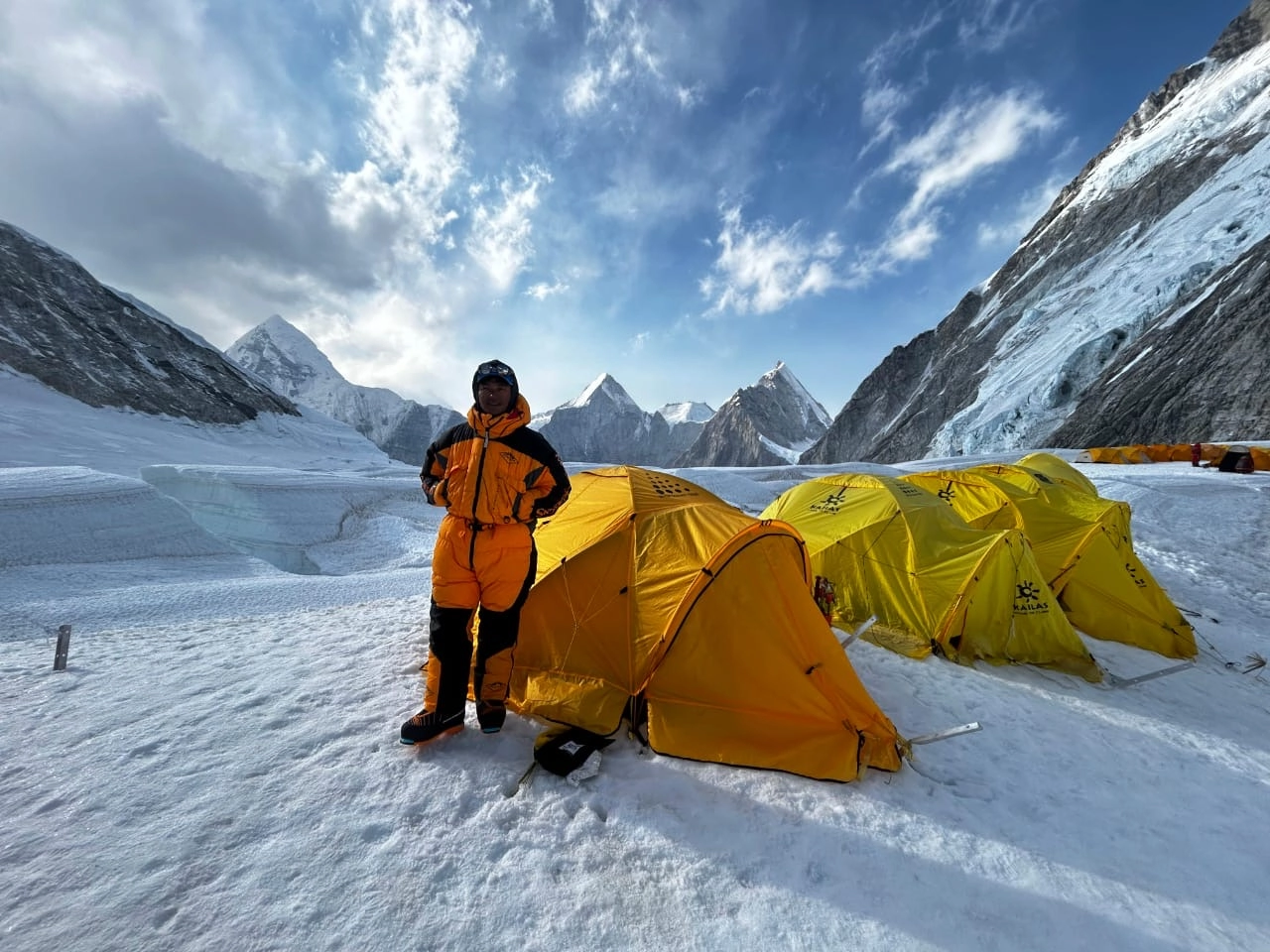
Lobuche East Peak Climbing

Lobuche East Peak Climbing

Trip Description

The Lobuche East Peak Climbing expedition is one of the most popular and rewarding high-altitude mountaineering objectives in the Everest Region, combining the legendary Everest Base Camp trail with a serious and technically engaging summit climb to 6,119 meters. It is an ideal expedition for experienced trekkers taking their first step into technical Himalayan mountaineering.

The journey begins with a scenic flight to Lukla and follows the classic Khumbu trail through Namche Bazaar, Tengboche, and Dingboche before turning toward the Lobuche Valley. The approach to High Camp passes alongside the Khumbu Glacier moraine, with the towering presence of Lobuche East growing more imposing with every step. A visit to Everest Base Camp is included in the itinerary, adding an iconic landmark to an already exceptional journey.

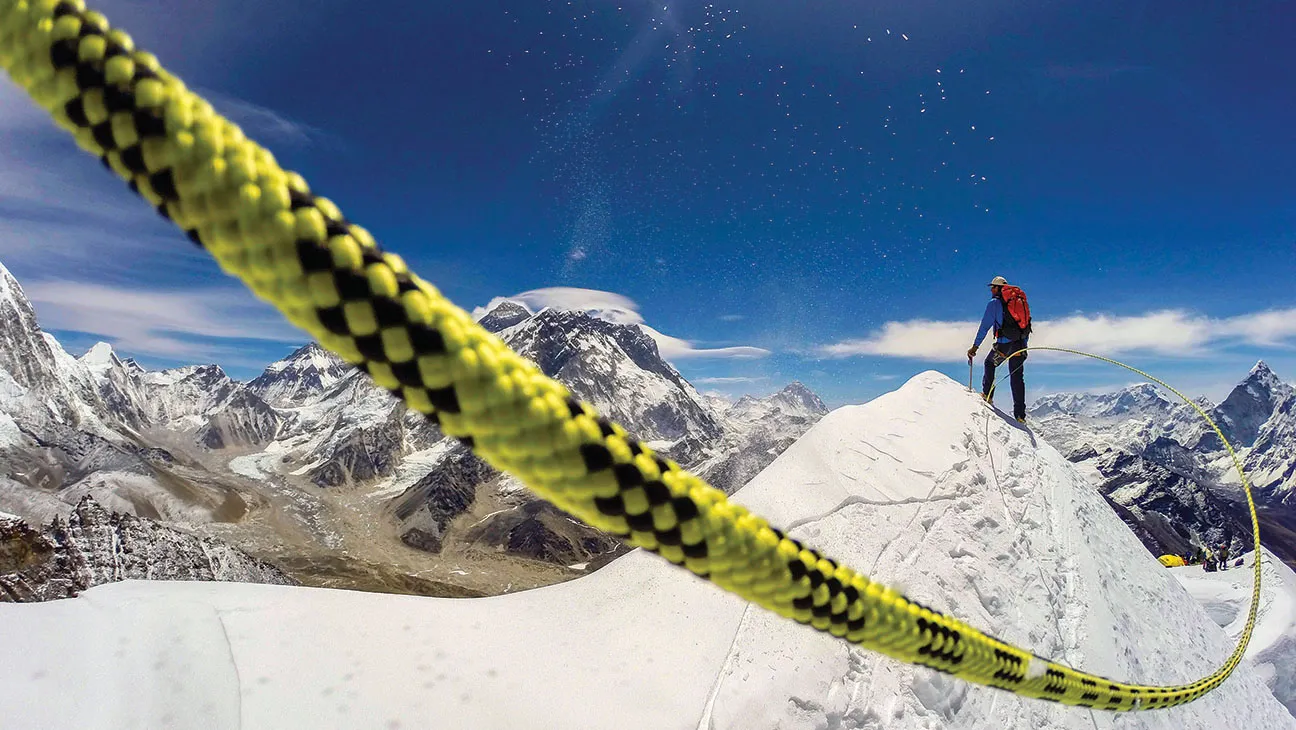
The technical section of the climb involves steep snow and ice slopes, fixed rope sections, and a demanding final ridge to the summit. The views from the top - spanning Everest, Lhotse, Makalu, Cho Oyu, Nuptse, and the full sweep of the Khumbu - are among the most spectacular rewards available on any 6,000-meter peak in Nepal.

With Virgin Nepal Trek & Expedition, you are guided by an experienced Sherpa climbing team with deep knowledge of Lobuche East, ensuring thorough preparation, strong technical support, and a safe and well-managed summit experience.

Culture of the Everest Region

The approach to Lobuche passes through the heartland of Sherpa culture in the Khumbu Valley. Monasteries, mani walls, and chorten-lined trails reflect a living Buddhist tradition that has shaped this mountain community for centuries. The spiritual atmosphere of Tengboche Monastery and the warmth of Sherpa teahouse hospitality along the route add a deeply human and culturally rich dimension to what is already an extraordinary mountaineering journey.

Best Season

Spring (March to May)

Stable weather, well-established routes, and moderate temperatures make spring the most reliable and popular season for Lobuche East.

Autumn (September to November)

Crisp, clear conditions and excellent mountain visibility offer a strong alternative season for this climb.

Contact our team for pricing, preparation guidance, and a custom climbing plan for Lobuche East.

highlights

Climb Lobuche East Peak at 6,119 meters in the Everest Region.
Combine the iconic Everest Base Camp trek with a technical Himalayan summit.
Experience steep snow and ice slopes, fixed ropes, and a challenging summit ridge.
Trek through Namche Bazaar, Tengboche, Dingboche, and the spectacular Khumbu Valley.
Enjoy breathtaking views of Everest, Lhotse, Makalu, Cho Oyu, and Nuptse.
Experience authentic Sherpa culture, monasteries, mani walls, and mountain hospitality.
Receive professional technical guidance and experienced Sherpa climbing support.
Best seasons: Spring (March–May) and Autumn (September–November).

Day by day Itinerary

Upon arrival at Tribhuvan International Airport,  a representative from Virgin Nepal Trek & Expedition will warmly welcome you and transfer you to your hotel in Kathmandu. After check-in and time to refresh, you will meet your expedition leader in the evening for a welcome briefing and dinner. Overnight stay in Kathmandu.


Max Altitude

1,300m/4,264 ft

Accommodation

Hotel in Kathmandu

Meals

Dinner

After breakfast, your trekking guide will conduct a full equipment inspection, including your sleeping bag, down jacket, and trekking boots. Any missing or inadequate gear can be purchased or rented in Kathmandu before departure. The remainder of the day is free to explore the city or rest before the expedition begins. Overnight stay in Kathmandu.


Max Altitude

1,400 m/ 4593 ft

Accommodation

Tea House

Meals

Breakfast

Flight Duration: Approximately 35 minutes

Trek Duration: Approximately 3-4 hours

An early morning scenic flight from Kathmandu lands at Tenzing-Hillary Airport in Lukla, offering panoramic views of the Langtang, Rolwaling, and Annapurna ranges along the way. After organizing equipment and porter loads, the trek begins through rhododendron and pine forests, crossing ridges and streams before arriving at Phakding for the evening. Overnight stay in Phakding.


Max Altitude

2,652 m / 8,700 ft

Accommodation

Tea house/ Hotel

Meals

Breakfast, Lunch, Dinner

Trek Duration: Approximately 5-6 hours

The trail follows the Dudh Koshi River through beautiful pine forests, crossing numerous suspension bridges including the famous Hillary Suspension Bridge. Passing through the villages of Benkar, Chumoa, and Monjo, the route reaches the Sagarmatha National Park entrance checkpoint at Jorsalle. A steady climb from the confluence of the Dudh Koshi and Bhote Koshi Rivers leads upward, with the first distant glimpse of Everest appearing above the Lhotse-Nuptse ridge just before Namche Bazaar - the vibrant trading capital of the Khumbu region. Overnight stay in Namche Bazaar.


Max Altitude

3,440m/11,280 ft

Accommodation

Teahouse / Guesthouse

Meals

Breakfast, Lunch, Dinner

A full acclimatization day in Namche Bazaar is essential before ascending further. Health experts recommend staying active on rest days rather than remaining sedentary. You may hike toward Thame village, visit Khunde, or explore Namche Bazaar itself - which offers government offices, ATMs, internet cafes, restaurants, and a lively Saturday market. The Sagarmatha National Park Visitor Centre near park headquarters is well worth a visit, featuring exhibits on Sherpa culture, Everest climbing history, and the region's diverse wildlife. Overnight stay in Namche Bazaar.


Max Altitude

3,440m/11,280 ft

Accommodation

Tea House /Lodge

Meals

All Meals [Breakfast, Lunch, Dinner]

Trek Duration: Approximately 5-6 hours

Leaving Namche Bazaar, the trail offers magnificent views of Everest, Nuptse, Lhotse, Ama Dablam, and Thamserku throughout the day. The route descends to Kayangjuma and continues to Sansa - the main trail junction for Gokyo Valley and Everest Base Camp - before crossing a prayer flag-adorned bridge over the Dudh Koshi River to Phunki Thenga for a relaxed lunch stop. A steady climb through pine forests leads to Tengboche, home to the largest Buddhist monastery in the Khumbu region and set against a spectacular backdrop of Ama Dablam, Nuptse, and Everest. Overnight stay in Tengboche.


Max Altitude

3,870 m / 12,694 ft

Accommodation

Tea House /Lodge

Meals

Breakfast, Lunch, Dinner

Trek Duration: Approximately 5-6 hours

The morning begins with photographs of Tengboche Monastery in the early light before the trail departs via the upper route toward Pangboche village, passing chortens, mani walls, and small settlements. After a lunch stop with close-up views of Ama Dablam, the route continues north to Pheriche or east beneath the towering north face of Ama Dablam into the Imja Valley. The final ascent of the day climbs steeply to Dingboche, a picturesque village surrounded by stone-walled fields growing barley, buckwheat, and potatoes. Overnight stay in Dingboche.


Max Altitude

4,360 m/ 14,300ft

Accommodation

Tea House /Lodge

Meals

Breakfast, Lunch, Dinner

A second acclimatization day is spent at Dingboche. A recommended hike to the ridge north of the village offers outstanding views of Ama Dablam, Lhotse, Makalu, and Cho Oyu - three of the world's six highest peaks visible from a single vantage point. To the west, the peaks of Cholatse (6,440 m) and Taboche (6,542 m) dominate the skyline, while the Lobuche East and West peaks are clearly visible to the northwest. The sweeping Imja Khola Valley and the farmlands of Dingboche below make this an excellent and rewarding acclimatization excursion. Overnight stay in Dingboche.


Max Altitude

4,360 m/14,300ft

Accommodation

Guesthouse/Lodge

Meals

Breakfast, Lunch, Dinner

Trek Duration: Approximately 6 hours

The day begins with a climb through the Khumbu Khola Valley toward Duglha, passing Dusa and the historic Phulung Karpo campsite used by the first successful Everest expedition in 1953. Above Phulung Karpo, the majestic profile of Pumori (7,138 m) comes into view. The route ascends steeply up the terminal moraine of the Khumbu Glacier to the Chupki Lhara ridge, where stone memorial cairns and prayer flags honor Scott Fischer and Babu Chiri Sherpa, among others who gave their lives on Everest. The trail then descends to the Khumbu Glacier moraine, with Khumbutse, Lingtren, Pumori, and the Mahalangur Himal filling the horizon as Lobuche comes into view. Overnight stay in Lobuche.

Max Altitude

4,940 m/16,210 ft

Accommodation

Hotel/Lodge

Meals

Breakfast, Lunch, Dinner

Trek Duration: Approximately 8-9 hours

The trail from Lobuche followas the lateral moraine of the Khumbu Glacier past the pyramid signpost toward Gorak Shep, with views of Pumori, Mahalangur, Lingtren, Khumbutse, and Nuptse along the way. A short ascent to Thangma Riju offers a 360-degree panorama of snow-covered peaks before the final approach to Gorak Shep. After lunch, the trek continues to Everest Base Camp alongside the dramatic Khumbu Glacier, where colorful expedition tents contrast with the grey glacial surroundings and the Khumbu Icefall rises impressively above. After celebrating this milestone, the team returns to Gorak Shep for the night. Overnight stay in Gorak Shep.


Max Altitude

5,170m/5,364m

Accommodation

Guesthouse/Lodge

Meals

Breakfast, Lunch, Dinner

Trek Duration: Approximately 7-8 hours

An early pre-dawn departure is required to reach Kala Patthar for sunrise. Temperatures typically range from -10 to -14 degrees Celsius at this hour, so warm layers are essential. The ascent passes Lingtren, Khumbutse, and Changtse as Everest gradually reveals itself. From the summit of Kala Patthar, a full 360-degree panoramic view of Everest and the surrounding Himalayan giants unfolds in extraordinary clarity. After spending time at the top, the team descends to Gorak Shep for breakfast before continuing to Lobuche to prepare for the climbing phase of the expedition. Overnight stay in Lobuche.

Max Altitude

5545m/18,192ft

Accommodation

Guesthouse/Lodge

Meals

All Meals [Breakfast, Lunch, Dinner]

Trek Duration: Approximately 3-4 hours

From Lobuche, the route heads toward Lobuche Base Camp across a relatively flat section before the trail becomes steeper and more rocky along the Lobuche Glacier. Views of Ama Dablam, Cholatse, Pokalde, Thamserku, and Kantega accompany the ascent. From Base Camp, a rocky moraine path continues to High Camp, where tents are set up and the team rests in preparation for the summit push. The technical climbing section above 5,770 meters involves ice and fixed rope, with the rope length and placement determined by the lead guide based on current conditions and season.

Pre-Climb Training: Your guide will provide hands-on training in peak climbing techniques and the correct use of technical equipment including ice axe, crampons, harness, and ascender. Rope ascent and descent techniques will also be practiced. This training session is an essential part of building the confidence and skills needed for a safe and successful summit.

Max Altitude

5,400m/17,712ft

Accommodation

Guesthouse/Lodge

Meals

Breakfast, Lunch, Dinner

Trek Duration: Approximately 8-10 hours

Summit day begins with a very early start at approximately 12:00 to 1:00 AM to reach the summit before noon, when afternoon winds at high altitude can become a serious obstacle. The initial section follows rocky terrain up to approximately 5,700 meters before transitioning to ice, where fixed and guide ropes are used as directed by the climbing leader.

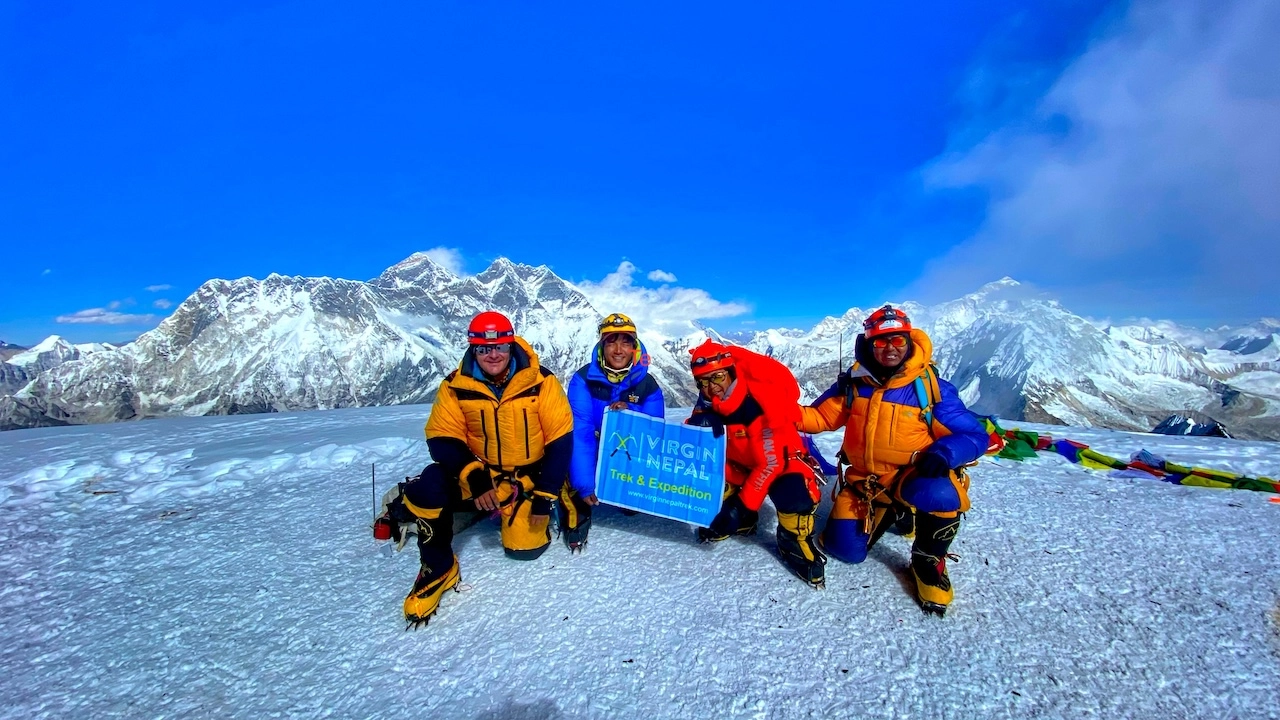
From the summit of Lobuche East at 6,119 meters, the panoramic views are extraordinary - Everest, Lhotse, Nuptse, Ama Dablam, Cholatse, and Pumori all visible in exceptional clarity. After celebrating this achievement and taking time to absorb the views, the team descends carefully back to High Camp for an overnight stay.

Max Altitude

6119m/20,070 ft

Accommodation

Tea House /Lodge

Meals

Breakfast, Lunch, Dinner

This additional day is built into the itinerary to manage any unforeseen challenges such as adverse weather conditions or scheduling delays. Having this buffer day ensures the expedition can continue without disruption, maximizing the opportunity for a successful summit. Overnight stay at High Camp or as directed by conditions.


Max Altitude

5,600m

Accommodation

Teahouse / Guesthouse

Meals

Breakfast, Lunch, Dinner

Trek Duration: Approximately 8-9 hours

After breakfast, the descent begins from Lobuche High Camp back to the main Everest Base Camp trail at Lobuche, where lunch is taken before continuing to Pheriche. The route offers magnificent views of Ama Dablam in the distance as the trail descends through hillsides of rhododendron and juniper. From Pheriche, the trail continues to Pangboche, where a visit to the historic Pangboche Monastery is recommended if time permits. Overnight stay in Pangboche.

Max Altitude

3930m /12900 ft

Accommodation

Hotel/Lodge

Meals

Breakfast, Lunch, Dinner

Trek Duration: Approximately 4-5 hours

The trail retraces the descent from Pangboche to the Imja Khola and climbs back through the forest to Tengboche, where lunch is taken and a visit to Tengboche Monastery is possible. The route continues through rhododendron and juniper forest before crossing the Dudh Koshi River bridge and descending rapidly through pine forest to Sansa. Wildlife including mountain goats, colorful pheasants, and occasionally snow leopards may be spotted along this section. The trail arrives at Namche Bazaar via the army camp. Overnight stay in Namche Bazaar.


Max Altitude

3,930 m /12,900 ft

Accommodation

Hotel/Lodge

Meals

Breakfast, Lunch, Dinner

Trek Duration: Approximately 6-8 hours

The final trekking day descends from Namche Bazaar on rocky trails and across multiple suspension bridges, with the air growing noticeably warmer as altitude decreases. The trail passes through familiar Sherpa villages before arriving in Lukla, marking the end of the mountain journey. The evening is a time to reflect on the expedition and celebrate its completion with the guide and porter team. Overnight stay in Lukla.


Max Altitude

2,865 m / 9,400 ft

Accommodation

Hotel/Lodge

Meals

Breakfast, Lunch, Dinner

Flight Duration: Approximately 35 minutes to Manthali, then drive to Kathmandu

An early morning flight departs Lukla for Manthali, followed by a scenic drive back to Kathmandu. After hotel check-in, the remainder of the day is free for relaxation, souvenir shopping in Thamel, or exploring any remaining landmarks in Kathmandu. In the evening, a farewell dinner hosted by Virgin Nepal Trek & Expedition celebrates the successful completion of the Lobuche East Peak expedition. Overnight stay in Kathmandu.

Max Altitude

1,300m/4,264 ft

Accommodation

Hotel/Lodge

Meals

Breakfast, Farewell Dinner

Your Nepal expedition comes to an end today. Depending on your international flight schedule, our representative will transfer you to Tribhuvan International Airport approximately 3 hours before departure. We hope the summit of Lobuche East and the journey through the Khumbu has been an unforgettable experience, and we look forward to welcoming you back to Nepal.


Max Altitude

1,300 m / 4,264 ft

Meals

Breakfast

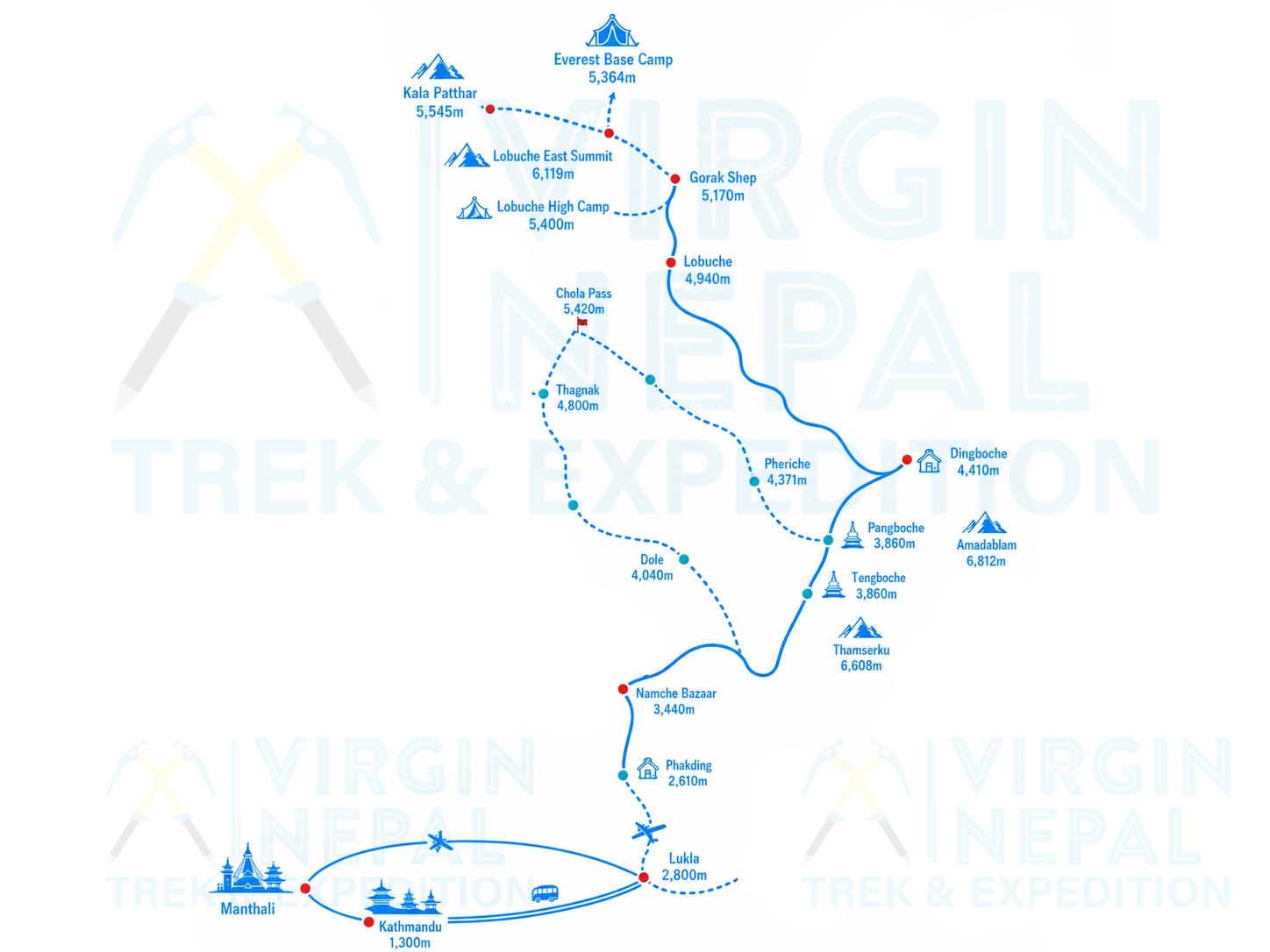
Route map

Lobuche East Peak Climbing Route Map

Inclusion & Exclusion

Inclusion
  • Airport pickup and drop-off in Kathmandu
  • Hotel accommodation in Kathmandu
  • Domestic flights as per itinerary
  • Lobuche Peak climbing permit and all government fees
  • Sagarmatha National Park permit and local fees
  • Experienced expedition leader and Sherpa climbing team
  • Base Camp and High Camp tents, kitchen tent, and staff
  • Full board meals at Base Camp
  • Tea house accommodation and all meals during the trek approach and return
  • Group climbing gear and fixed rope logistics
  • Basic medical kit and emergency coordination
  • Farewell dinner in Kathmandu
Exclusion
  • International airfare and Nepal visa fees
  • Personal travel and rescue insurance
  • Personal climbing and trekking gear
  • Extra hotel nights due to delays
  • Personal snacks, beverages, and laundry services
  • Tips for guides and crew
  • Any personal expenses not listed in the inclusions

Expedition preparation

Essential Gear

Clothing: High-altitude down jacket, thermal base layers, insulated mid-layer, waterproof shell jacket and pants, climbing gloves and liners, warm hat, sun hat, and thermal socks.

Footwear: Double mountaineering boots, trekking shoes, camp shoes, and gaiters.

Climbing Equipment: Harness, crampons, ice axe, helmet, ascender, descender, carabiners, and headlamp with spare batteries.

Personal Items: UV-protection sunglasses, sunscreen, lip balm, reusable water bottles, sleeping bag rated to -15 degrees Celsius (5 degrees Fahrenheit), trekking poles, personal medications, and toiletries.

Preparation Advice

Physical Preparation: Begin training at least 3 to 4 months before departure. Focus on cardiovascular endurance, stair climbing, and long hikes with a loaded pack to build the stamina required for sustained high-altitude effort.

Technical Preparation: Prior experience with crampons, ice axe, and fixed rope techniques is essential. A mountaineering skills course before departure is strongly recommended for first-time technical climbers.

Altitude Awareness: The climb reaches 6,119 meters. The acclimatization days built into the itinerary are essential - follow the schedule carefully and never push through warning signs of altitude sickness.

Mental Preparation: Summit day on Lobuche East is long, cold, and demanding. Strong focus, trust in your guide, and a calm and methodical approach will make the decisive difference.

Insurance: Choose a policy that covers technical high-altitude climbing and helicopter evacuation at full expedition altitudes.

Gear Preparation: All technical equipment must be tested and familiar before departure. Practice crampon and ice axe techniques during training if you are new to alpine climbing.

Terms & Conditions

Booking and Payment: A booking deposit is required to confirm your expedition reservation. The remaining balance must be paid in full before the expedition departure date. Please contact our team for specific deposit and payment schedule details.

Travel Insurance: All expedition members must carry valid travel insurance covering technical high-altitude climbing and emergency helicopter evacuation in Nepal. Coverage must extend to at least 6,500 meters.

Flight Delays and Itinerary Changes: Flights to and from Lukla and Manthali are weather dependent. Delays or itinerary adjustments may occur for safety reasons, and any additional costs incurred as a result are the responsibility of the client.

Guide and Safety Authority: All clients are required to follow the instructions of the expedition leader and Sherpa climbing team at all times. Virgin Nepal Trek & Expedition reserves the right to modify or abort the summit attempt if necessary to ensure the safety and wellbeing of all participants.

Cancellation Policy: All cancellations must be submitted in writing via email or through our official communication channels. Refund eligibility and the amount refunded will depend on how far in advance the cancellation request is received before the scheduled trip, service, or booking date. Cancellations made well in advance may qualify for a partial or full refund, while late cancellations may incur cancellation charges due to operational and administrative costs. Failure to attend without prior notice may result in the booking being treated as non-refundable.In the event that Virgin Nepal Trek & Expedition must cancel or reschedule a trip or service, guests will be offered an alternative departure date, travel credit, or refund where applicable. Refund processing times may vary depending on the payment method and financial institution. Certain deposits, permit fees, or third-party service charges may be non-refundable. Please contact our team directly for complete cancellation terms, refund details, and policy information related to your booking.

Talk our Expert

Virgin Nepal Trek and Expedition

Your Trusted Himalayan Adventure Partner

Backed by veteran Sherpa guides and decades of mountain experience, the Virgin Nepal Trek provides expert consultation for all Himalayan treks and technical climbs. From custom itinerary planning and safety protocols to permits and ground logistics, our specialist team is available 24/7 to help you plan a safe and unforgettable journey in the Himalayas.

Share Your Experience

Write a Review

Related Packages

Ama Dablam Expedition

30 days
22,349 ft (6,812 m)
extreme
$12,000.00 / per person

Everest South Expedition 2027

60 days
8,848.86 m
extreme
$60,000.00 / per person

Himlung Himal Expedition

29 days
23,379 ft (7,126 m)
hard
$12,000.00 / per person

Mera Peak Climbing

16 days
21,247 ft (6,476 m)
hard
$3,800.00 / per person

Manaslu Expedition

36 days
26,781 ft (8,163 m)
very_hard
$0.00 / per person

Related blogs

The World's 14 or 20? Nepal's New 8,000m Peak Proposal

Nepal's 20 Peaks Proposal: An Introduction
Nepal is seeking international recognition for six additional Himalayan summits above 8,000 metres, a proposal that could reshape the traditional list of the world's highest mountains. If internationally accepted, the number of recognized eight-thousanders could increase from 14 to 20, while Nepal's national inventory would expand from eight to 14.

The proposal was formally presented by the Nepal Mountaineering Association (NMA) during the 2026 General Assembly of the International Climbing and Mountaineering Federation (UIAA), held in Kathmandu, Nepal, on 30–31 October.
NMA President presented a scientific and geographical case for recognizing six additional summits as independent mountains. The proposal focuses on their individual geographical identities, distinct summit characteristics, separate climbing routes and significance to local Himalayan communities.
If the international mountaineering community accepts the proposal, the traditional 14 Peaks challenge could evolve into a 20 Peaks challenge, creating new possibilities for high-altitude mountaineering, expedition tourism and Himalayan mountain research.
For Nepal, the initiative represents more than a change in mountain statistics. It is an opportunity to bring greater international attention to the extraordinary geographical and mountaineering heritage of the Himalayas.

 
Which Six New 8,000-Metre Peaks Has Nepal Proposed?
The Nepal Mountaineering Association has requested international consideration of six additional Himalayan summits located in the Kanchenjunga and Lhotse mountain ranges.
According to Nepal's published national mountain inventory, the six proposed eight-thousanders are:
Proposed mountain Elevation Mountain range Region
Yalung Kang 8,505 m Kanchenjunga Taplejung
Kanchenjunga South 8,476 m Kanchenjunga Taplejung
Kanchenjunga Central 8,473 m Kanchenjunga Taplejung
Lhotse Middle 8,410 m Lhotse Solukhumbu
Lhotse Shar 8,400 m Lhotse Solukhumbu
Kanchenjunga West 8,077 m Kanchenjunga Taplejung
Mountain naming note: The 8,077 m summit is also called Yalung Kang West in some reporting. Published reports have also presented differing Yalung Kang elevation figures. The table follows the Department of Tourism's published 8,505 m figure and the alternative Kanchenjunga West naming reported during the 2026 assembly.
Four of the proposed summits belong to the Kanchenjunga massif in eastern Nepal, while two are associated with the Lhotse massif in the Everest region.
These summits are not being proposed simply because they exceed 8,000 metres. Nepal argues that each represents a distinct mountaineering objective with its own geographical characteristics and climbing significance.

 
Why Does Nepal Want Six More 8,000-Metre Mountains Recognized?
For decades, the international mountaineering community has traditionally recognized 14 independent mountains above 8,000 metres across the Himalayan and Karakoram ranges. These mountains are commonly known as the 14 Eight-Thousanders, representing one of the most prestigious achievements in high-altitude mountaineering.
However, the distinction between an independent mountain, a subsidiary summit and a secondary top along a mountain ridge has remained a subject of geographical and mountaineering debate. The Nepal Mountaineering Association and the Government of Nepal argue that six additional summits deserve individual consideration.
The scientific and geographical arguments presented by Nepal include:
  • 1. Geographical identity
    Each proposed summit has its own geographical characteristics and identifiable position within its mountain massif.
  • 2. Distinct summit structures
    The proposal emphasizes the physical separation and individual characteristics of the summits.
  • 3. Independent climbing routes
    Each summit represents a separate climbing objective. Reaching one summit does not automatically mean reaching another.
  • 4. Historical climbing records
    The proposed mountains have their own mountaineering histories, climbing routes and expedition documentation.
  • 5. Local mountain identity
    The names and identities of these summits are also connected to the historical understanding of mountains among Himalayan communities.
The central question is whether these summits satisfy internationally accepted criteria for classification as independent mountains rather than subsidiary peaks.

 
What Does the UIAA Say About the 8,000-Metre Peak Debate?
The International Climbing and Mountaineering Federation has previously examined the question of whether the traditional 14 eight-thousanders should be expanded.
In its position paper published on 27 February 2024, the UIAA Mountaineering Commission acknowledged that there is no universally accepted geographical definition distinguishing every mountain from a subsidiary summit or topographic point. The UIAA considered topographical characteristics, climbing history, local communities and mountaineering traditions.
Its position at that time supported retaining the traditional 14 peaks as the classic internationally recognized list, while acknowledging that Nepal could maintain a larger national inventory.
Nepal's renewed presentation during the 2026 Kathmandu General Assembly brings this discussion back to the international mountaineering community. The distinction is important: Nepal's national recognition and international recognition by the wider mountaineering community are two separate matters.

The Traditional 14 Eight-Thousanders vs Nepal's Proposed 20 Peaks
The traditional international list includes 14 independent mountains above 8,000 metres, distributed across Nepal, China and Pakistan. Nepal currently has eight mountains in this traditional international list. Following the Government of Nepal's addition of six more summits to its national inventory, the country's prospective total is now 14.
 
Nepal's eight traditionally recognized 8,000-metre mountains
Mountain Elevation
Mount Everest 8,848.86 m
Kanchenjunga 8,586 m
Lhotse 8,516 m
Makalu 8,463 m
Cho Oyu 8,201 m
Dhaulagiri I 8,167 m
Manaslu 8,163 m
Annapurna I 8,091 m
 
How could the international list change?
 
Category Traditional list If all six proposals are accepted
Globally recognized independent 8,000ers                        14 20
Mountains in Nepal's national inventory                          8 14
Additional proposed summits                          0 6
 
The proposed change would make Nepal's national inventory particularly significant in the global mountaineering landscape. However, the 20-mountain figure remains a potential outcome rather than an officially established international classification.

 
How Could Nepal's 20 Peaks Proposal Change Global Mountaineering?
The proposed expansion could have implications beyond geographical classification. It could influence mountaineering achievements, expedition planning, tourism development and the international profile of Nepal's mountain regions.
 
1. A New Challenge for Elite High-Altitude Mountaineers
The traditional 14 Peaks challenge is one of the most demanding achievements in professional mountaineering. Climbing all 14 internationally recognized eight-thousanders requires exceptional physical conditioning, technical experience, high-altitude preparation and considerable expedition resources.
If the six additional summits receive international recognition, elite climbers could have a new 20 Peaks objective. This could create new discussions around climbing records, summit verification, expedition documentation and the definition of completing all the world's independent eight-thousanders.
 
2. Greater International Attention on the Kanchenjunga Region
The Kanchenjunga massif in eastern Nepal is among the most remarkable and remote high-altitude mountain regions in the Himalayas. Located in Taplejung District, the region is known for its dramatic mountain scenery, remote valleys, challenging terrain and exceptional