What is the EBC Trek?
The EBC trek refers to the Everest Base Camp route on the south side in Nepal, sitting at an altitude of 5,364 meters. While there is also a northern base camp on the Chinese side at 5,200 meters accessible by vehicle, the southern base camp in Nepal can only be reached on foot—or by helicopter!
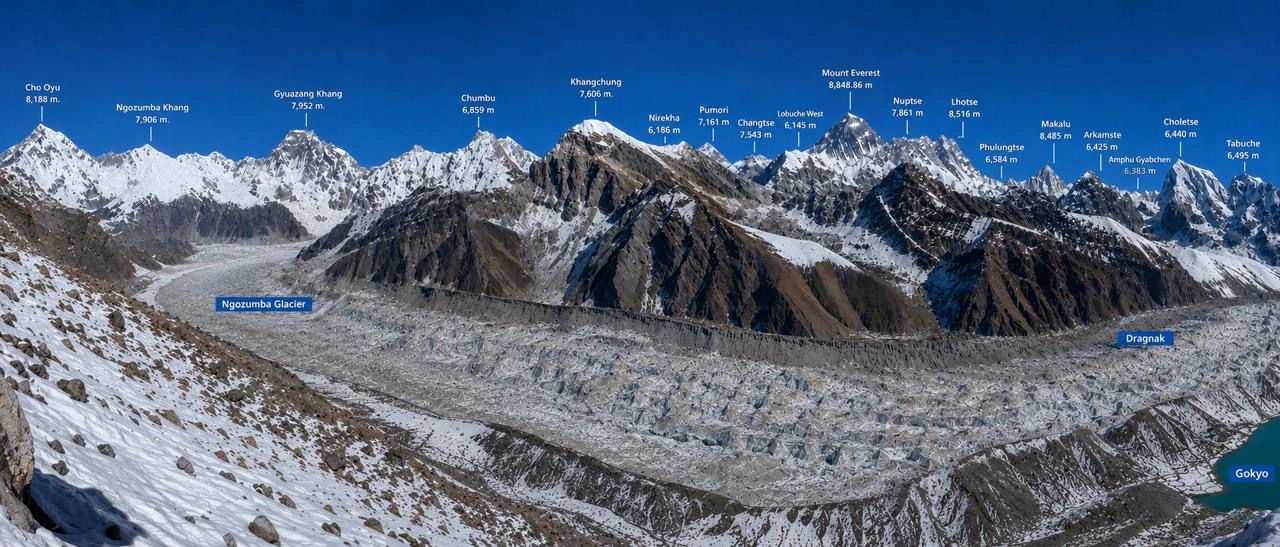
This high-altitude trek offers breathtaking scenery. On a clear day, you can view Mt. Everest, Lhotse (8,516m, the world's 4iterth) and Nuptse (7,855m), Makalu (8,463m, the world's fifth highest), as well as Changtse, Pumori, Gyachung Kang, and Cho Oyu (8,201m, the world's sixth highest).
.webp)
Everest Region Trekking Route Map
The standard Everest Base Camp trek in Nepal is a round-trip route using Gorak Shep as the final viewing destination. Within the base camp region, you can also complete a larger circuit featuring the sacred Gokyo Lakes to the west and Chhukhung to the east. This grand circuit includes three high mountain passes: Renjo La, Cho La, and Kongma La.
-
Standard EBC Round-Trip: Takes about 10–13 days.
-
Three Passes Grand Circuit: Takes about 20–25 days.
Journey Begins: Kathmandu & Thamel
Flying via CA407 from Chengdu, transiting through Lhasa, and arriving in Kathmandu, I made sure to request a window seat on the right side during check-in for a chance to catch a glimpse of Everest.

Before reaching Lhasa, the endless chain of snow-capped mountains was already breathtaking. However, once our flight departed from Gonggar Airport, thick clouds rolled in, blocking everything from view. True to expectation, when we landed in Kathmandu, it was completely overcast. I could only hope for clearer skies on the return flight.
Returning to Kathmandu after two years, I expected some urban development, but everything remained wonderfully unchanged. While some travelers dislike Kathmandu for its poor infrastructure, heavy traffic, and dust, to me, this city is the starting point of my dreams. The spiritual comfort it provides is beyond material comparison, and it remains wonderfully simple and grounded.

Kathmandu's street life feels reminiscent of southern Chinese towns during the early days of economic reform—unpretentious, bustling, and full of life.
Despite the earthquake damage from over a year ago still visible across the city, the resilience of the people working to heal their nation is inspiring.
During my stay, I finally visited the famous "Monkey Temple" (Swayambhunath), making up for missing it last trip. There are so many monkeys! Legend says Buddha once visited here, making it a sacred pilgrimage site. Although the main structure suffered minor damage during the recent earthquake, the surrounding smaller stupas collapsed.
After resting and gathering necessary supplies in Kathmandu, I based myself in Thamel—the city’s bustling commercial hub. For anyone preparing to head into the mountains, it is the ultimate one-stop shop where you can find any trekking gear you might need. Plus, the abundance of Chinese restaurants is a great bonus.